Showing posts with label flowers. Show all posts

Saturday, August 3, 2013

Calabasa


Since we began in earnest this spring, our garden has been a wonderfully fun experiment with a respectable amount of success, to boot.  Above are our first two pumpkins harvested. The one on the left weighs 14.2 pounds, and the one on the right weighs a little less, 11.2 pounds.

But after those first two were harvested a couple weeks ago, there seemed to be no more pumpkins, sadly. So I decided to brush up on my third grade botany, and quickly realized that the male and female flowers are easy to differentiate.


You can see above that the male flower on the left has a single anther, and the female on the right has a stigma with several fronds. Behind the showy part of the flower, the female flowers have a very noticeable ovary, or as I like to call them, proto-pumpkin (below). 

After observing the flowers over a few days, I noticed two problems.  Not only did males flowers outnumber female flowers three-to-one, but the female flowers were not developing into fruit!  Instead, the little proto-pumpkins shriveled up a day or so after the flower withered.

So in retaliation to the poor reproduction rate, I have used a soft paintbrush to pollinate the female flowers myself during the past few days.  Yesterday, while searching for female flowers to pollinate, I found this sneaky little pumpkin growing in the shade of other plants:

Woo-hoo! These squash plants have been so easy and fun to grow, I can't wait to try some interesting heirloom varieties next time. I have a particular weakness for Cinderella (AKA fairytale) pumpkins, which are supposed to be as tasty as they are pretty. I also have a passion for Halloween and Dia de los Muertos, so I am really looking forward to autumn this year.

But that's not to say I want summer to be over too soon. So far, the summer of 2013 has brought us a lot of rain. In July alone we were lucky enough to get 3.6 inches of precipitation. 

Rain also spurs almost every desert critter to reproduce. We've tolerated the mosquitoes and other annoying bugs, but the worst plague so far has been an onslaught of caterpillars that came to a head last week. The green monsters decimated both the pepper plants and the cabbages in our garden. Thanks to their rapacious appetites, our first promising pepper was a very sad, premature harvest.


If you like our Facebook Page, then you might remember that back in March we were gifted a cutting from a Terlingua Creek cottonwood tree. We planted that cutting (basically just stuck it in the dirt and watered it) in front of the Last Resort, and it has really been growing like a weed, despite the constant nibbling of insects.

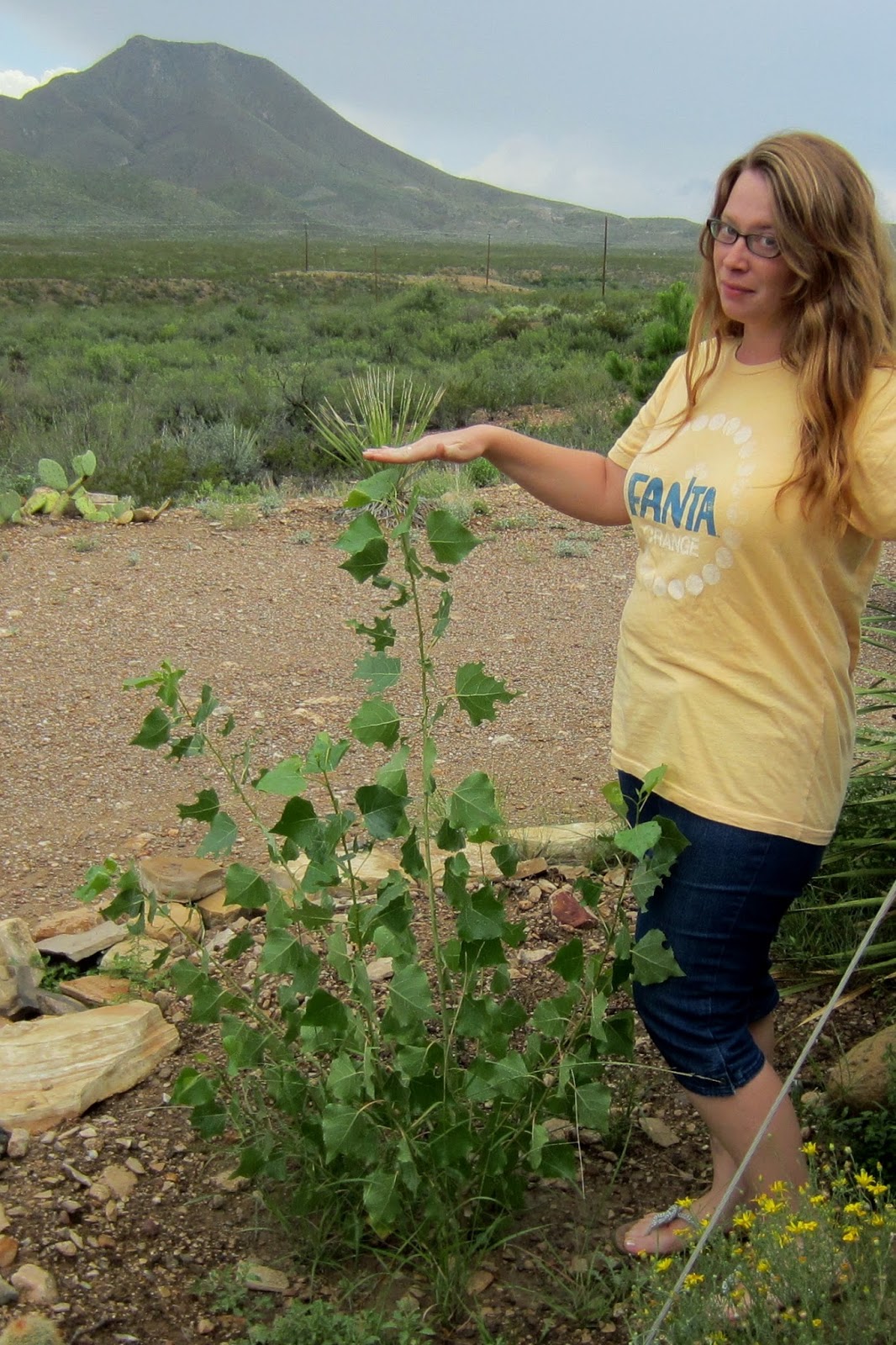
On the left is the original cottonwood tree cutting just after we got it home. It was just over 12" long back on March 20th of this year.

About four months later, it stood four feet tall and didn't show any signs of slowing down. It has already grown inches in the days since the photo on the right was taken.

The sapling is a reminder that despite the many challenges,  it is possible for something not only to survive, but even thrive. Every day we learn more about gardening in general, and about the peculiarities specific to growing in the mountains of the Chihuahuan Desert, but there is still so much wisdom yet to be acquired.

Tuesday, March 12, 2013

Primavera


Spring has officially sprung! And thanks to all that glorious winter precipitation, the vernal flowers seem to be exploding! Almost every yucca is blooming or about to bloom, there are bluebonnets up and down the roads, ocotillo are putting out red buds, and the whole desert is starting to green.


There is still a lot of dead foliage about thanks to the drought, but plants that did survive seem to be recovering very well, now that we have had some precipitation.  Another rain would do us all some good, though, as the roads are getting pretty dusty again.


And while the flowers are very confident that it is now Spring, the thermometer is less certain. The weather keeps bouncing between balmy 70-80 degree days and 60 degree nights, to cold and windy days with near-freezing temperatures at night.

And of course the turistas know that it is Spring, because they have flooded into the Big Bend for Spring Break vacations. It is good to see the shops and hotels and restaurants bustling with activity, but I think we'll just keep working on Solar and avoid town for a while. Although it may be hard to stay away from the National Park with all these gorgeous flowers blooming...


Saturday, October 27, 2012

Limoncillo


Since we've got so many flowers blooming right now, we thought it would be a good investment to buy a plant identification guide from the BBNP bookstore (instead of spending hours on the Lady Bird Johnson website and getting mixed results).  Of course, the real books are several hundred pages long and cost over $20, so we cheaped-out and got the laminated pamphlet version.  

We already own the "Snakes of the Trans-Pecos" pamphlet and we love it, so this little "Plants of the Chihuahuan Desert" field guide seemed like a good alternative to the more expensive, full length book.

It's really amazing how many plants we assumed were just scrubby brush that are now showing some beautiful flowers.  There are also so many flowers that we've enjoyed for years now, that we hadn't previously been able to identify.  Here are some new IDs we've been able to make, thanks to our new field guide (plus a little help from wildflower.org).


  1. Black dalea (Dalea frutescens)
  2. Skeleton-leaf goldeneye (Viguiera stenoloba)
  3. Trailing windmills (Allionia incarnata)
  4. Bristly nama (Nama hispidum)
  5. Mock vervain (Glandularia bipinnatifida)
  6. Desert evening primrose (Oenothera primiveris)
But there are still a number of flowers and plants that are a complete mystery.  Since we had such good luck with Botaniker helping us ID the Lindheimer's Senna, we thought we might post the mystery plants too, and hope that someone out there savvier than us can ID them.

Here are the mystery plants:


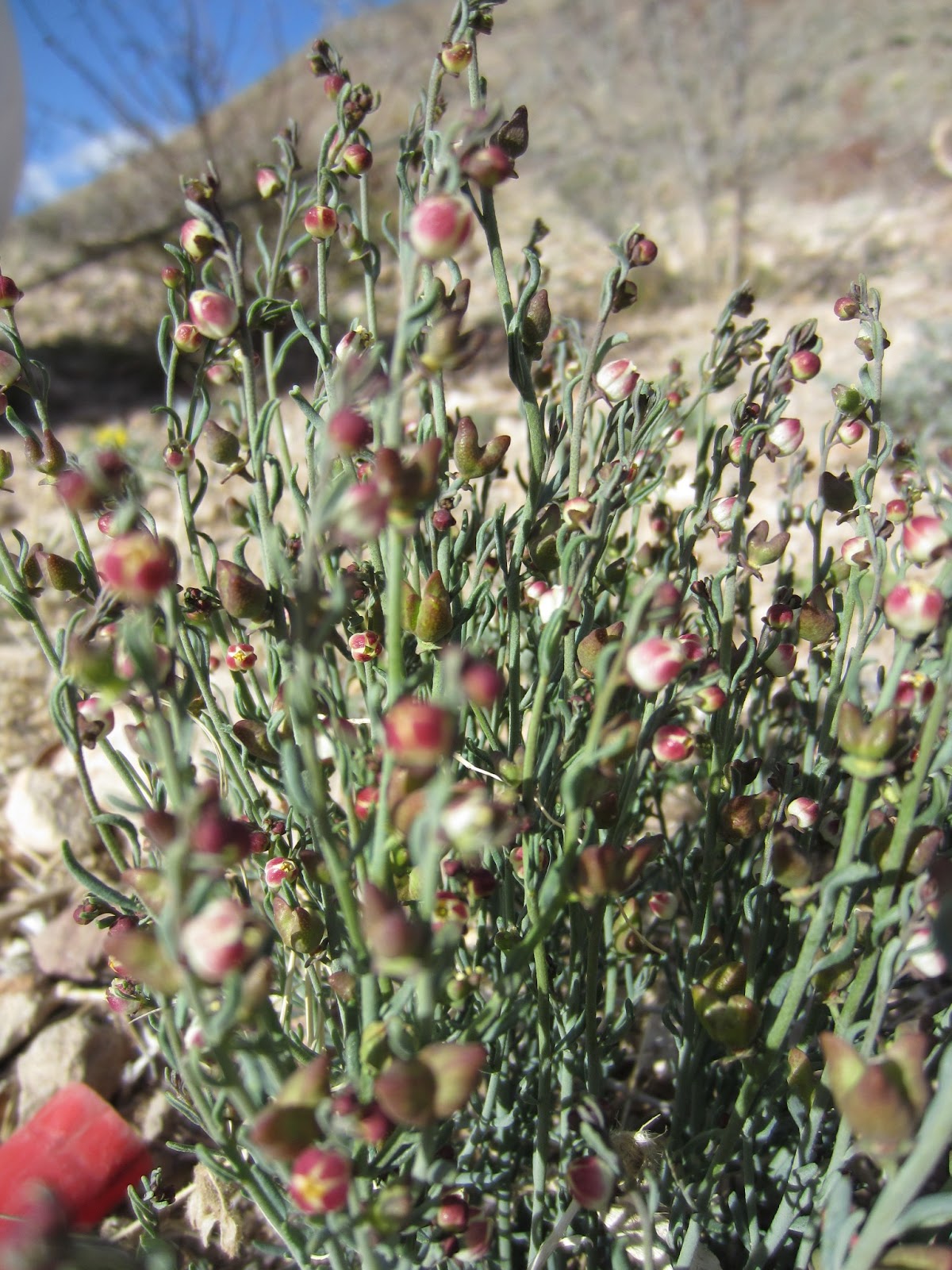
This dark plant is a total mystery, especially since there weren't any open blooms to help. The purple/gray color is so unusual, and we haven't seen any more since these photos were taken.


This thistley, prickly plant is very common, but is not in our booklet.  We'd love to know more about it, since it is all over.


Yellow is the most common color for flowers out here, but even the ones that look the same are often different species.  At first we thought this flower was skeleton-leaf goldeneye, but on closer inspection it doesn't match at all.


This creeping succulent is beautiful even when it's not flowering, but the tiny pink/purple flowers make the plant seem even more delicate and lovely.


This strange flower is one we have never seen before or since. What in the heck is it?

The dark vine pictured above had several tiny, rose-like blooms along its length, but only the one pictured was open and ready for a close-up.

But here's the real star of this blog entry (I know, I know ... too many flower photos): Pectis angustifolia.  More commonly known in these parts as 'limoncillo,' this wild herb has an amazingly strong lemony fragrance and it is often dried to be used for tea or flavoring. 


Not a horse.
The first time someone told us about limoncillo, we thought he had said 'lemonsilla,' and when we Googled it, we found lots of pictures of horses, but no flowers. Another case where wildflower.org helped point us in the correct direction!

Friday, October 26, 2012

Tuesday, October 23, 2012

Friday, October 19, 2012

Plant ID


Clockwise from top left:
Datura, a/k/a Jimson weed;
Desert marigold;
Drummond clematis, a/k/a 'old man's beard';
Beebrush;
Cenizo;
Yellow trumpetflower?

I'm not sure about the last one, so if you think I'm wrong and know the correct ID, please tell us in the comments :-)

Sunday, August 19, 2012

Wet Stuff


That funny, wet stuff has been falling from the sky quite a bit lately.  We took the photo above Saturday morning, after it rained all night Friday.  Then it rained slow and steady on Saturday night, and we got another light shower this afternoon. Three days in a row of precipitation feels mighty nice.


But it also means the bug population is exploding. Whenever it rains, the termites bubble up from the ground and fly into the air, like some weird, effervescent entomological eruption. But lately we're nearing plague-like proportions.

 And also coming out to eat all these tasty morsels are the arachnids and other bug-hunters.

The chickens are doing their part to eat as many bugs as they can catch.

And the kittens have become such good hunters that they can snatch them right out of the air most of the time.

The prolonged rain should lead to another flower bloom, also.  The lechugillas are the most recent plants to bloom in our area, and I think they can be underrated.  Some people don't realize they bloom at all, but they actually have a very pretty display if you catch the show in time and get up close to the action.

Lechugillas are agaves, and their flowers are similar to those of the century plant.  But unlike the century plant which blooms only once, right before it dies, lechugilla agaves bloom every year.


The rain also shows off how well camouflaged Wrinkles is in her desert environs.  Her red leopard pattern mimics the dappled color of our wet, volcanic sand perfectly.